A supply chain management perspective
by aBCD Consulting
What cross-docking is and how it works
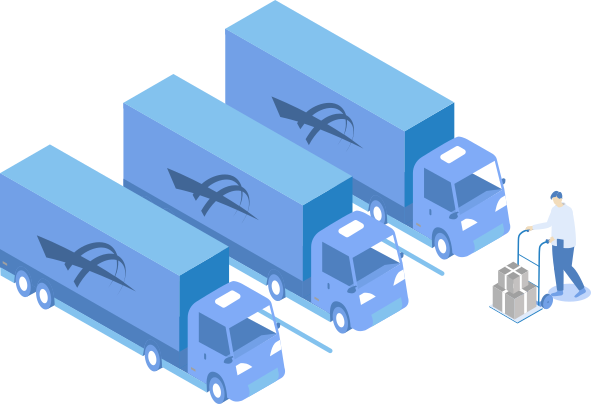
Cross-docking is a logistics technique that involves transferring goods directly from receiving docks to shipping docks, with minimal or no storage time. In a cross-docking system, incoming products are sorted and redirected to outbound delivery vehicles without passing through traditional storage: in this model, the warehouse becomes a transit point rather than a storage point. The result is a drastic reduction in supply chain throughput times, storage costs and internal handling. Cross-docking requires precise synchronisation between inbound and outbound flows, supported by advanced information systems and very accurate logistics planning.
When to apply cross-docking in the supply chain
Cross-docking is not a universal solution: it works best in specific contexts. It is particularly suited to fast-moving and perishable products, where minimising storage time is both a quality and an economic requirement. It is effective for handling products already sorted by destination by the supplier, which require no further picking or consolidation. It also works well for replenishing stores in a retail network, where quantities per destination are predetermined and flows are regular and predictable. Conversely, it is not suited to supply chains with highly variable demand, products that require inspection or processing before distribution, or contexts where inbound and outbound flows cannot be sufficiently synchronised.
Advantages and disadvantages of cross-docking for business logistics
The advantages of cross-docking are significant and well documented: lower storage costs, shorter delivery times, less need for physical warehouse space, and fewer picking activities and stockouts. In contexts where distribution speed is a critical competitive factor, such as large-scale retail, fashion or e-commerce, these benefits translate directly into a market advantage. The disadvantages, however, should not be underestimated. Cross-docking requires specific infrastructure, with enough docks and a suitable layout, and very precise synchronisation between suppliers and carriers. Dependence on the punctuality of inbound flows is high: a delay upstream can block the entire operation.
Tipologie di cross docking: modelli e soluzioni operative
Il cross docking non è un modello operativo monolitico: esistono diverse varianti, ciascuna con caratteristiche, requisiti e ambiti di applicazione specifici. La scelta del modello più adatto dipende dalla struttura della supply chain, dal tipo di prodotto gestito e dal grado di collaborazione raggiungibile con i fornitori. Conoscere le principali tipologie disponibili è il punto di partenza per valutare quale approccio sia realmente implementabile nella propria realtà operativa e quali investimenti richieda.
Pre-distribution and post-distribution cross-docking
In pre-distribution cross-docking, suppliers prepare and label goods for their final destination before shipping them to the cross-docking centre: on arrival, the parcels are simply sorted and routed to outbound vehicles, with no need to open or repack them. This model is the simplest operationally and offers the fastest throughput times, but it requires structured collaboration with suppliers and standardised upstream preparation processes. In post-distribution cross-docking, goods arrive in larger logistics units that are opened and sorted by destination inside the cross-docking centre. This model offers greater flexibility but involves more intensive operations and longer throughput times.
Hybrid cross-docking
The hybrid model combines elements of pure cross-docking with temporary storage, to handle the inevitable mismatches between inbound and outbound flows. In practice, goods that arrive before the destination vehicle is ready are placed in a temporary buffer zone, not in permanent storage, and retrieved when they are actually shipped. This approach reduces the rigidity of pure cross-docking while retaining its main advantages in terms of speed and lower storage costs. Hybrid cross-docking is the solution adopted by most logistics operations approaching this model, because it makes it possible to handle operational variability without giving up the benefits of direct flow.
The phases of the cross-docking process
The effectiveness of cross-docking depends largely on how well each operational phase is carried out. Unlike in a traditional warehouse, where an error at receiving can be corrected before shipping, in cross-docking the compressed timescales leave little room for correction: every phase must work precisely, because inefficiencies immediately spread downstream. Understanding the process sequence and the critical points of each phase is essential to design a cross-docking operation that is truly reliable and scalable.
Receiving and sorting goods
Receiving is a critical phase in cross-docking: the speed and accuracy with which goods are identified, checked and sorted shape the entire downstream process. When the vehicle arrives, the logistics units are scanned and matched to destination orders in the WMS, which automatically generates sorting instructions for staff. The quality of identification at this stage, through barcodes, RFID or QR codes, is decisive: an inbound sorting error spreads along the entire distribution chain with no chance of correction.
Consolidation, order fulfilment and shipping
In the consolidation phase, logistics units sorted by destination are grouped and prepared for shipping. Depending on the model adopted, this phase can be very quick (pre-distribution cross-docking) or require picking and repacking (post-distribution). The WMS coordinates this phase by generating load lists for each outbound vehicle, managing the loading sequence by destination and producing shipping documents. Vehicle departure punctuality is the most critical performance indicator in cross-docking: any delay at this stage translates directly into delays at final destinations.
Practical examples and success stories in cross-docking
Logistics literature and field experience agree on one point: cross-docking works, but the best results come when it is applied in the right contexts and with the right preparation. Analysing concrete examples of implementation, in the sectors and warehouse types where this model has reached its full potential, is useful not only for inspiration, but above all for identifying the enabling conditions behind its success and assessing whether they can be replicated in your own business.
Applications in automated warehouses
In automated warehouses, cross-docking reaches its maximum efficiency. Automatic sorting systems, such as belt sorters, cross-belt sorters and shoe sorters, can process thousands of parcels per hour with a minimal error rate, synchronising inbound and outbound flows in real time. Integration between the WMS, the automation control system and carriers’ tracking systems makes it possible to dynamically optimise the sorting sequence according to the actual arrival time of vehicles. In these contexts, cross-docking becomes an almost fully automated process, with staff focused on control, exception handling and system supervision.
Case studies in food and retail
Large-scale retail is the sector where cross-docking has found its most established and mature applications. Large-scale retail distribution centres often operate on a cross-docking basis for fresh and ultra-fresh products, where speed of throughput is an absolute requirement to guarantee product quality on the shelves. Similarly, in fashion retail, cross-docking is used to distribute new collections to stores: goods arrive from suppliers already labelled by store and are distributed on the day they arrive, minimising the risk of obsolescence and ensuring a simultaneous launch across the entire network.
Automation and enabling technologies for cross-docking
Cross-docking is, by nature, a process with high operational and time intensity: the speed at which goods are identified, sorted and dispatched is the main factor determining its efficiency. In this context, automation and digital technologies are key levers for achieving the precision and speed the model requires. Technological developments in recent years have made increasingly accessible and integrated solutions available, opening up cross-docking even to companies that until recently could not have met its operational requirements.
IT and management systems: WMS, RFID and other tools
Cross-docking is a process that cannot do without adequate technological support. The WMS is the core system: it must be able to synchronise inbound and outbound flows in real time, generate operating instructions for staff and monitor process progress. RFID, where adopted, speeds up identification and sorting, eliminating the bottlenecks caused by manual barcode scanning. Carrier track & trace systems, integrated with the WMS, provide advance visibility of arrivals, making it possible to organise resources proactively. Supplier collaboration platforms also allow information on incoming shipments to be received in advance, which is essential for planning sorting operations before the goods physically arrive.
The impact of logistics 4.0
Logistics 4.0 is amplifying the potential of cross-docking by integrating technologies that until a few years ago were the exclusive preserve of the largest multinationals. Autonomous mobile robots working alongside operators in sorting operations, machine vision systems for automatic goods identification, and AI-based optimisation platforms that rework sorting plans in real time in response to changing flows: these technologies are making cross-docking faster, more accurate and more resilient to operational variability. For companies considering adopting or optimising a cross-docking model, the availability of these technologies, which are increasingly accessible even to mid-sized companies, opens up improvement opportunities worth exploring with the support of specialist consultants.
Want to implement cross-docking to streamline your supply chain? Contact aBCD Consulting
Cross-docking can radically transform the efficiency of your supply chain, but it requires careful design and expert technical support to be implemented correctly.
aBCD Consulting helps companies assess the feasibility of cross-docking in their operating context, design the process model, select the enabling technologies and manage the implementation project.
If you want to find out whether cross-docking is the right solution for your logistics operation, contact us for a preliminary, no-obligation analysis.